
Kurt Geiger Kindness Foundation
Business by Design academy by Kurt Geiger Kindness Foundation
(
Philanthropic organization
)
#SDGAction59713
Description
The Kurt Geiger Kindness Foundation’s mission is to build a more inclusive creative industry by breaking down barriers for underrepresented young people. In alignment with the UN Sustainable Development Goals - particularly Quality Education (SDG 4), Decent Work (SDG 8), and Reduced Inequalities (SDG 10) - we provide young people with the support, skills and opportunities that they need to overcome barriers. Our journey began with funding grassroots charities embedded in their local communities to spark creativity and confidence in young people. Building on this, we launched Business by Design academy (BBD) - an innovative, co-designed programme transforming access to creative careers for underrepresented 18–24-year-olds in London. Fully funded by the Foundation and free for participants, Business by Design academy offers AQA-accredited unit awards, over 200 hours of learning, paid work experience, mentorship, and all expenses covered. Since inception, we have raised over £2 million to deliver this model, equipping participants with the skills, networks, and confidence to succeed in a sector where diversity is long overdue.
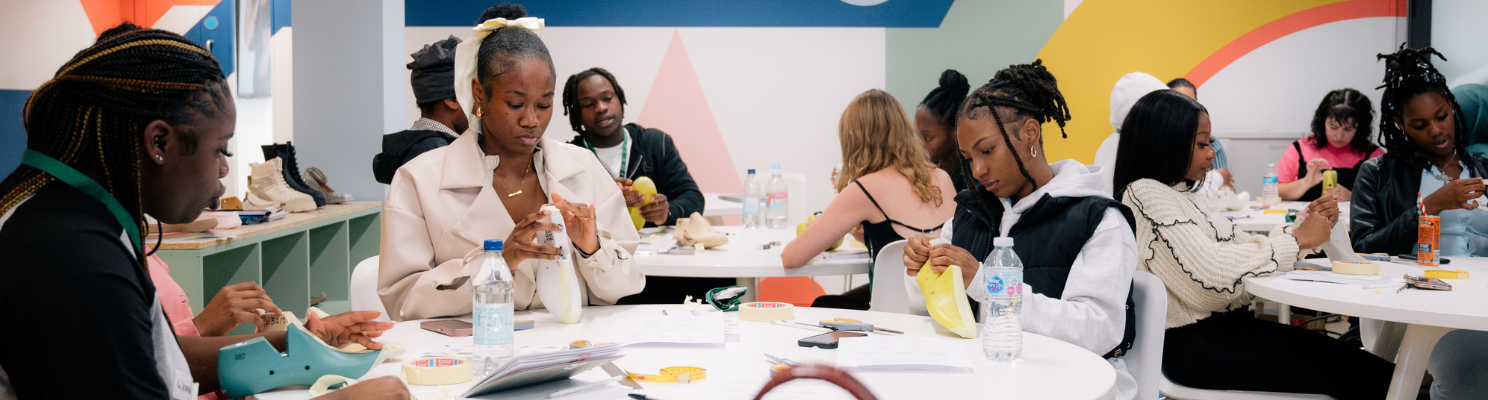
In collaboration with an Advisory Board (aged 18–25), the Kindness Foundation Trustees launched Business by Design in January 2024, followed by a larger second cohort in September 2024. Situated in Farringdon, a hub of London’s creative industries, Kurt Geiger’s headquarters houses creative experts but talent shouldn’t be confined within office walls. Recognising our responsibility, we converted a showroom into a learning studio, connecting young people with our professional community. In just one year, we doubled our cohort size and teaching days, welcoming 50+ young Londoners from underrepresented backgrounds. Students are immersed in all aspects of a fashion business through masterclasses led by Kurt Geiger professionals. They rotate through key departments, spending a month in each:
- Design – From sourcing luxurious materials to dreaming up designs, students learn how creative ideas become standout collections.
- Buying & Merchandising – Students uncover the secrets of collection planning and pricing strategy, ensuring the right styles hit shelves at the right time.
- Wholesale & Retail – They explore selling strategies across different markets and craft in-store experiences that keep customers coming back.
- Marketing & PR – Students discover how campaigns, influencer partnerships and media strategies turn brands into household names.
- Finance & HR – They gain insight into cost management, recruitment, team development and career guidance.
- E-Commerce – Students understand the power of digital growth through online customer engagement and e-commerce strategy.
With over 50 Kurt Geiger professionals delivering masterclasses and more than 800 hours of employee volunteering, students benefit from immersive learning, real-world exposure, and direct access to industry expertise. Following each module, they anchor their learning in hands-on sessions. For example, after their Design masterclass, they practise CAD, use Adobe Illustrator and simulate briefing a supplier.
Our capacity-building approach centres on equipping young people with the skills, tools, and networks they need to succeed in creative careers and beyond. Each student is paired with a trained mentor from Kurt Geiger whose professional role aligns with the student’s career aspirations. These mentors provide ongoing coaching, personal insight, and professional development support throughout the programme. The curriculum combines masterclasses with an enrichment programme covering both creative and business skills. Students receive practical training in Excel, Adobe Photoshop and Illustrator, as well as business coaching and specialist workshops such as shoemaking and supplier development. They are further inspired by guest speakers including celebrity stylist Romario Chevoy, the Flag Twins (publishers), Ibrahim Kamara (co-founder of GUAP magazine), and social entrepreneur Jeremiah Emmanuel. To remove barriers to digital access, each student is loaned a laptop for the duration of the programme, enabling full participation in training, project work, and independent study. This combination of technology access, professional mentorship, and industry-standard training builds transferable skills - from digital fluency to entrepreneurial thinking - supporting participants’ long-term employability and leadership potential in the creative sector.
The initiative falls under the Kurt Geiger Kindness Foundation (a UK-registered charity), which is governed by a Board of Trustees - including executive staff from the Kurt Geiger business. This ensures the Foundation’s mission is embedded within the company’s values and operations, and that we are actively bridging the gap between young people and industry.
The board also includes independent trustees: Bernadette Hagans, a disability advocate and inclusive fashion campaigner, and Jeremiah Emmanuel, a youth engagement expert with a background in social justice and community leadership. Their expertise helps keep the initiative inclusive and forward-thinking. Business by Design is led by Sophia Johnson, an educator who created the learning curriculum in direct response to the barriers young people face in accessing creative careers. Building on our Youth Council’s legacy, a Youth Advisory Board is now being established to maintain ongoing youth leadership in decision-making and keep the programme responsive to participants’ needs.
Evaluation is central to ensuring Business by Design delivers meaningful, lasting impact. We use a rigorous combination of qualitative and quantitative evaluation methods to assess programme effectiveness and long-term impact. Each cohort begins with a baseline assessment to understand the skills, aspirations, and support needs of participants. This ensures the programme remains student-centred and responsive from the outset. Ongoing evaluation includes pre- and post-programme surveys, feedback sessions, mentor reflections and alumni tracking. This feedback loop drives continuous improvement and allows us to refine our approach in real time. For example, in response to student feedback, we introduced new wellbeing, resilience and future-planning modules in our second cohort resulting in a rise in the number of students who felt supported in their personal development (from 80% to 93%). By embedding robust evaluation into our model, we remain accountable to our participants, partners and funders, while building a growing evidence base to refine, strengthen, and scale the programme.
- Impact Highlights Skills Development: 97% of students reported improved technical skills, from design software to Excel and visual storytelling. Each participant earned an average of nine AQA Unit Awards, formalising learning achievements.
- Industry Knowledge: 99% said masterclasses and hands-on sessions gave them new, industry-relevant knowledge.
- Mentorship & Support: 99% felt supported by mentors and tutors throughout the programme.
- Professional Confidence: 91% felt more confident navigating professional environments, and 100% improved their understanding of professional etiquette.
- Career Readiness: 90% felt better equipped to enter the creative industry, and over 85% improved their communication skills.
- Engagement & Retention: Commitment remained high, with an average attendance rate of 83% across 272+ hours of in-person learning, and a 98% programme retention rate.
- Corporate Contribution: More than 1,500 hours of employee volunteering have supported the academy to date. Business by Design creates sustainable pathways into the creative sector, ensuring participants’ success extends well beyond the programme.
Our alumni data shows:
- Career Progression: Over 85% of graduates in full-time roles now work within the creative industries.
- Further Education: 26% have progressed to further study, including prestigious institutions such as the London College of Fashion.
- Entrepreneurship: 21% have launched their own ventures - from styling agencies and jewellery brands to fashion labels.
- Enduring Optimism: 100% would recommend the programme and reported feeling optimistic about their career after graduating.
These outcomes show that Business by Design does more than equip students with technical knowledge, it builds confidence, vision, and agency. Whether graduates become employees, entrepreneurs, or students, they leave with the tools, networks, and resilience to shape their own futures and contribute to a more inclusive creative industry.
Kurt Geiger
SDGS & Targets
Goal 4
Ensure inclusive and equitable quality education and promote lifelong learning opportunities for all
4.1
By 2030, ensure that all girls and boys complete free, equitable and quality primary and secondary education leading to relevant and effective learning outcomes
4.1.1
Proportion of children and young people (a) in grades 2/3; (b) at the end of primary; and (c) at the end of lower secondary achieving at least a minimum proficiency level in (i) reading and (ii) mathematics, by sex
4.1.2
Completion rate (primary education, lower secondary education, upper secondary education)
4.2
By 2030, ensure that all girls and boys have access to quality early childhood development, care and pre-primary education so that they are ready for primary education
4.2.1
Proportion of children aged 24–59 months who are developmentally on track in health, learning and psychosocial well-being, by sex
4.2.2
Participation rate in organized learning (one year before the official primary entry age), by sex
4.3
By 2030, ensure equal access for all women and men to affordable and quality technical, vocational and tertiary education, including university
4.3.1
Participation rate of youth and adults in formal and non-formal education and training in the previous 12 months, by sex
4.4
By 2030, substantially increase the number of youth and adults who have relevant skills, including technical and vocational skills, for employment, decent jobs and entrepreneurship
4.4.1
Proportion of youth and adults with information and communications technology (ICT) skills, by type of skill
4.5
4.5.1
Parity indices (female/male, rural/urban, bottom/top wealth quintile and others such as disability status, indigenous peoples and conflict-affected, as data become available) for all education indicators on this list that can be disaggregated
4.6
By 2030, ensure that all youth and a substantial proportion of adults, both men and women, achieve literacy and numeracy
4.6.1
Youth/adult literacy rate
4.7
By 2030, ensure that all learners acquire the knowledge and skills needed to promote sustainable development, including, among others, through education for sustainable development and sustainable lifestyles, human rights, gender equality, promotion of a culture of peace and non-violence, global citizenship and appreciation of cultural diversity and of culture’s contribution to sustainable development
4.7.1
Extent to which (i) global citizenship education and (ii) education for sustainable development are mainstreamed in (a) national education policies; (b) curricula; (c) teacher education and (d) student assessment
4.a
Build and upgrade education facilities that are child, disability and gender sensitive and provide safe, non-violent, inclusive and effective learning environments for all
4.a.1
Proportion of schools offering basic services, by type of service
4.b
4.b.1
Volume of official development assistance flows for scholarships
4.c
By 2030, substantially increase the supply of qualified teachers, including through international cooperation for teacher training in developing countries, especially least developed countries and small island developing States
4.c.1
Proportion of teachers with the minimum required qualifications, by education level
Goal 8
Promote sustained, inclusive and sustainable economic growth, full and productive employment and decent work for all
8.1
8.1.1
Annual growth rate of real GDP per capita
8.2
Achieve higher levels of economic productivity through diversification, technological upgrading and innovation, including through a focus on high-value added and labour-intensive sectors
8.2.1
Annual growth rate of real GDP per employed person
8.3
Promote development-oriented policies that support productive activities, decent job creation, entrepreneurship, creativity and innovation, and encourage the formalization and growth of micro-, small- and medium-sized enterprises, including through access to financial services
8.3.1
Proportion of informal employment in total employment, by sector and sex
8.4
Improve progressively, through 2030, global resource efficiency in consumption and production and endeavour to decouple economic growth from environmental degradation, in accordance with the 10-Year Framework of Programmes on Sustainable Consumption and Production, with developed countries taking the lead
8.4.1
Material footprint, material footprint per capita, and material footprint per GDP
8.4.2
Domestic material consumption, domestic material consumption per capita, and domestic material consumption per GDP
8.5
8.5.1
Average hourly earnings of female and male employees, by occupation, age and persons with disabilities
8.5.2
Unemployment rate, by sex, age and persons with disabilities
8.6
8.6.1
Proportion of youth (aged 15-24 years) not in education, employment or training
8.7
Take immediate and effective measures to eradicate forced labour, end modern slavery and human trafficking and secure the prohibition and elimination of the worst forms of child labour, including recruitment and use of child soldiers, and by 2025 end child labour in all its forms
8.7.1
Proportion and number of children aged 5‑17 years engaged in child labour, by sex and age
8.8
Protect labour rights and promote safe and secure working environments for all workers, including migrant workers, in particular women migrants, and those in precarious employment
8.8.1
Fatal and non-fatal occupational injuries per 100,000 workers, by sex and migrant status
8.8.2
Level of national compliance with labour rights (freedom of association and collective bargaining) based on International Labour Organization (ILO) textual sources and national legislation, by sex and migrant status
8.9
By 2030, devise and implement policies to promote sustainable tourism that creates jobs and promotes local culture and products
8.9.1
Tourism direct GDP as a proportion of total GDP and in growth rate
8.10
Strengthen the capacity of domestic financial institutions to encourage and expand access to banking, insurance and financial services for all
8.10.1
(a) Number of commercial bank branches per 100,000 adults and (b) number of automated teller machines (ATMs) per 100,000 adults
8.10.2
Proportion of adults (15 years and older) with an account at a bank or other financial institution or with a mobile-money-service provider
8.a
8.a.1
Aid for Trade commitments and disbursements
8.b
By 2020, develop and operationalize a global strategy for youth employment and implement the Global Jobs Pact of the International Labour Organization
8.b.1
Existence of a developed and operationalized national strategy for youth employment, as a distinct strategy or as part of a national employment strategy
Goal 10
Reduce inequality within and among countries
10.1
By 2030, progressively achieve and sustain income growth of the bottom 40 per cent of the population at a rate higher than the national average
10.1.1
Growth rates of household expenditure or income per capita among the bottom 40 per cent of the population and the total population
10.2
By 2030, empower and promote the social, economic and political inclusion of all, irrespective of age, sex, disability, race, ethnicity, origin, religion or economic or other status
10.2.1
Proportion of people living below 50 per cent of median income, by sex, age and persons with disabilities
10.3
Ensure equal opportunity and reduce inequalities of outcome, including by eliminating discriminatory laws, policies and practices and promoting appropriate legislation, policies and action in this regard
10.3.1
Proportion of population reporting having personally felt discriminated against or harassed within the previous 12 months on the basis of a ground of discrimination prohibited under international human rights law
10.4
Adopt policies, especially fiscal, wage and social protection policies, and progressively achieve greater equality
10.4.1
Labour share of GDP
10.4.2
Redistributive impact of fiscal policy on the Gini index
10.5
Improve the regulation and monitoring of global financial markets and institutions and strengthen the implementation of such regulations
10.5.1
Financial Soundness Indicators
10.6
10.6.1
Proportion of members and voting rights of developing countries in international organizations
10.7
Facilitate orderly, safe, regular and responsible migration and mobility of people, including through the implementation of planned and well-managed migration policies
10.7.1
Recruitment cost borne by employee as a proportion of montlhy income earned in country of destination
10.7.2
Number of countries with migration policies that facilitate orderly, safe, regular and responsible migration and mobility of people
10.7.3
Number of people who died or disappeared in the process of migration towards an international destination
10.7.4
Proportion of the population who are refugees, by country of origin
10.a
10.a.1
Proportion of tariff lines applied to imports from least developed countries and developing countries with zero-tariff
10.b
10.b.1
Total resource flows for development (e.g. official development assistance, foreign direct investment and other flows)
10.c
By 2030, reduce to less than 3 per cent the transaction costs of migrant remittances and eliminate remittance corridors with costs higher than 5 per cent
10.c.1
Remittance costs as a proportion of the amount remitted
SDG 14 targets covered
| Name | Description |
|---|
Deliverables & Timeline
Welcomed the first cohort into the newly launched academy, offering hands-on learning. The programme was co-designed with industry professionals and young people to equip underrepresented young creatives with skills, experience and networks.
Launched the second cohort and in response to growing demand, the academy expanded its reach by 58%. Programme delivery scaled through increased industry partnerships, deeper community outreach and new creative pathways.
We will welcome a third cohort into our expanded academy creative studio. The scale-up came after a 130% increase in applications, highlighting both rising demand and a widening gap in accessible fashion education for marginalised young people.
Introduce a youth advisory board to place lived experience at the heart of decision-making. Students from academy cohorts will meet with staff and leadership to shape strategy, culture and curriculum ensuring the academy remains inclusive and responsive.
Resources mobilized
Partnership Progress
Feedback
Action Network


Share


Timeline
Entity
Other beneficiaries
We designed Business By Design to reach those most often left out of the creative industry. That’s why our entry criteria prioritise applicants who have faced structural barriers to entering the creative industry - whether due to financial hardship, lack of family networks, or systemic discrimination. We don’t ask for qualifications or industry experience; instead, we ask about ambition, need, and potential.
Who We Serve:
- Over 87% of our students identify as being part of underrepresented backgrounds.
- 64% come from low-income households (earning under £25,000 and/or receiving Universal Credit).
- Over half are from families where neither parent went to university and 15% identify as having a disability.
- 88% of our most recent cohort self-identified as facing barriers to entering the creative sector - including discrimination, a lack of networks, and financial hardship. Just 4% of our students reported difficulties accessing the programme - a remarkably low figure in light of widely recognised educational and digital inequities in the UK. While comparable data specific to creative industry access isn't readily available, this statistic underscores how intentionally inclusive design and strong wraparound support can significantly reduce barriers.
By removing traditional gatekeeping and intentionally designing for inclusion, Business by Design is building a more diverse and equitable pipeline of future creative talent, directly contributing to SDG 4 (Quality Education), SDG 8 (Decent Work), and SDG 10 (Reduced Inequalities).
More information
Countries


Contact Information
Ella Geering, Kurt Geiger Kindness Foundation Officer