The Global Sustainable Development Report (GSDR) originated in “The Future We Want,” the outcome of the Rio+20 conference on sustainable development, when Member States were laying the groundwork for the 2030 Agenda for Sustainable Development and the 17 associated Sustainable Development Goals (SDGs). The negotiators knew that the 2030 Agenda would be complex, and unprecedented in ambition, and that a siloed approach to development would not be adequate. They recognized the power of science to understand and navigate relationships among social, environmental and economic development objectives, and so they called for a report to strengthen the science-policy interface.
In 2016, Member States decided that the report should be produced once every four years, to inform the quadrennial SDG review deliberations (SDG Summit) at the General Assembly, and that it should be written by an Independent Group of Scientists appointed by the Secretary-General. They mandated that the Group would consist of 15 experts representing a variety of backgrounds, scientific disciplines and institutions, ensuring geographical and gender balance.
The 2019 Global Sustainable Development Report, The Future is Now: Science for Achieving Sustainable Development, was the first report prepared by an Independent Group of Scientists appointed by the United Nations Secretary-General. The 2023 Global Sustainable Development Report, "Times of Crisis, Times of Change: Science for Accelerating Transformations to Sustainable Development", is the second.
The 2023 GSDR Times of Crisis, Times of Change: Science for Accelerating Transformations to Sustainable Development was a key input for the 2023 SDG Summit. At the 2023 SDG Summit and the 2024 Summit of the Future, UN Member States reaffirmed their commitment to the 2030 Agenda and acceleration of the SDGs. Informed by the GSDR’s systemic approach to the SDGs, the UN system identified six transitions where interventions could unlock across the board gains. These are: (1) food systems; (2) energy access and affordability; (3) digital connectivity; (4) education; (5) jobs and social protection; and (6) climate change, biodiversity loss and pollution. In the follow up, government actors at all levels are being supported to work collaboratively across ministries and engage civil society and other non-government partners in rolling out these transitions.
The next report is scheduled for release in September 2027 ahead of the High-level Political Forum on sustainable development to be held under the auspices of the General Assembly (SDG Summit).
Global Sustainable Development Report 2027
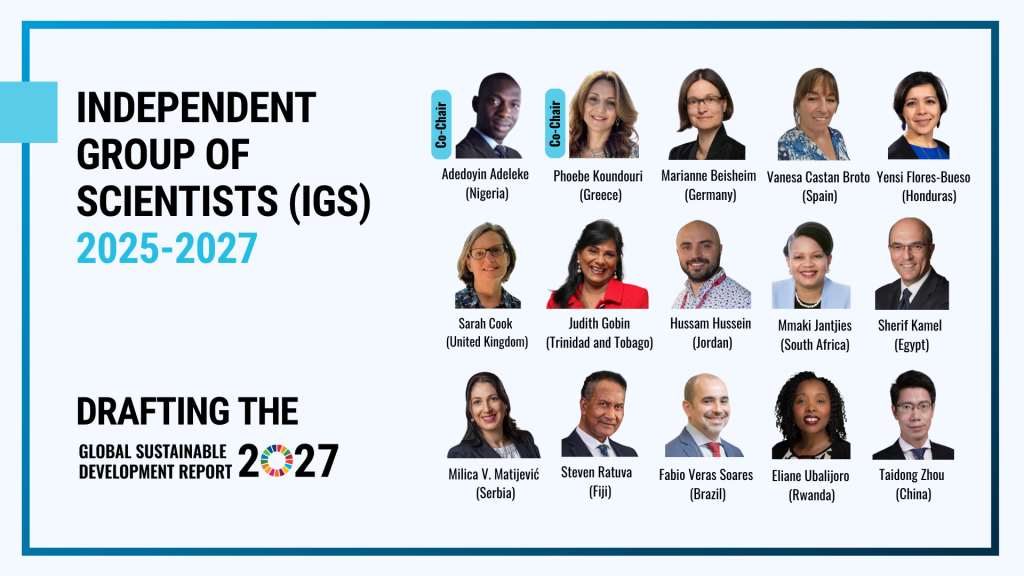
United Nations Secretary-General António Guterres has appointed a new group of independent scientists to draft the 2027 Global Sustainable Development Report (GSDR). The report will aim to strengthen the science-policy-society interface and serve as a robust, evidence-based tool to support policymakers in accelerating progress toward poverty eradication and sustainable development in the final push to 2030.
This group is expected to launch the 2027 GSDR in September of 2027 in advance of the High-Level Political Forum under the auspices of the UN General Assembly (SDG Summit), providing scientific guidance on the state of global sustainable development, addressing emerging challenges, and offering actionable recommendations for governments and other stakeholders.
Building on the legacy of previous reports, the 2027 GSDR will be accessible to a wide range of stakeholders, including policymakers, business leaders, civil society organizations, and the general public.
